GEO for Online Shops: Why Product Feeds Need to Be Readable for AI
June 2026
GEO stands for Generative Engine Optimization. Why product feeds, variants and structured data are becoming the visibility foundation for AI shopping.
SEO has long been the most important foundation for visibility in search. For online shops, a new area is now emerging: GEO.
GEO stands for Generative Engine Optimization. It refers to the optimisation of content and data for generative search systems — systems that don't just show links but generate answers, comparisons, recommendations and product selections.
For e-commerce, this is decisive.
Because when customers no longer just search by product name but describe what they need to an AI, products need to be prepared differently.
Not just for people. But for systems that read, compare and build shopping results from product data.
How product search via AI works
A classic search term might be: 'reflective dog lead'.
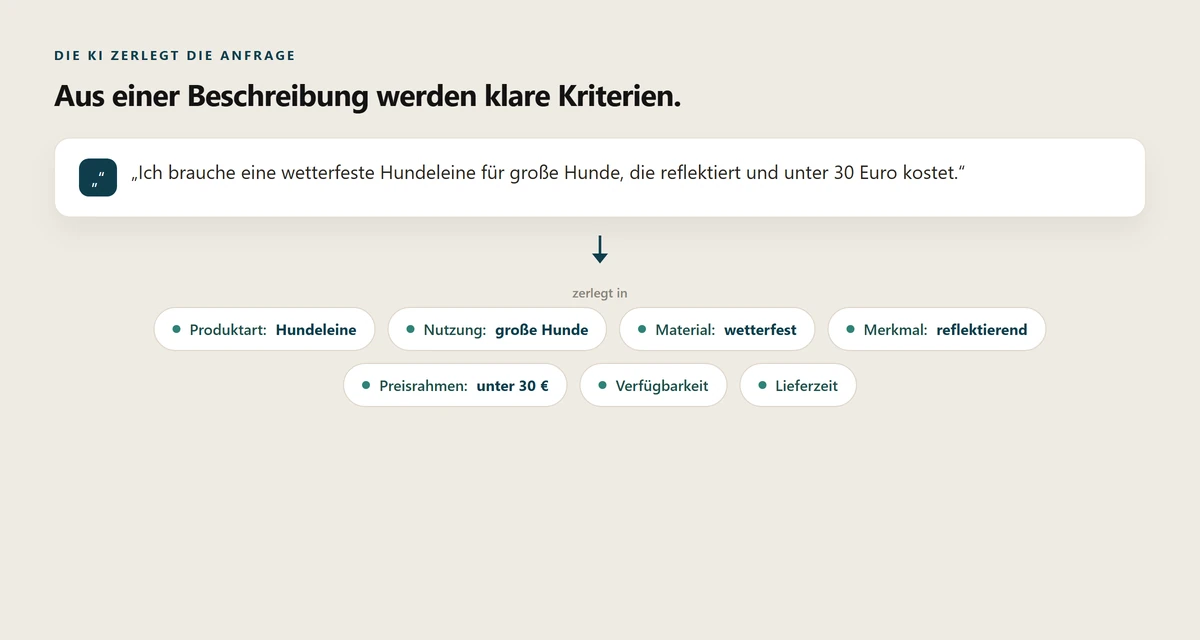
An AI query sounds more like: 'I need a robust reflective lead for two large dogs, preferably weatherproof, not too heavy and under 40 euros.'
That's a different kind of search. The AI doesn't just look for a keyword. It breaks down the query into attributes: product type, use case, material, size, load capacity, colour, price, availability, target group, delivery conditions.
It then checks which products match. A product can only be considered well if this information is clearly present.
If key characteristics are buried in description text, poorly maintained or not clearly assigned across variants, it becomes difficult.
What AI shopping will display
AI shopping will not just be a list of shop links.
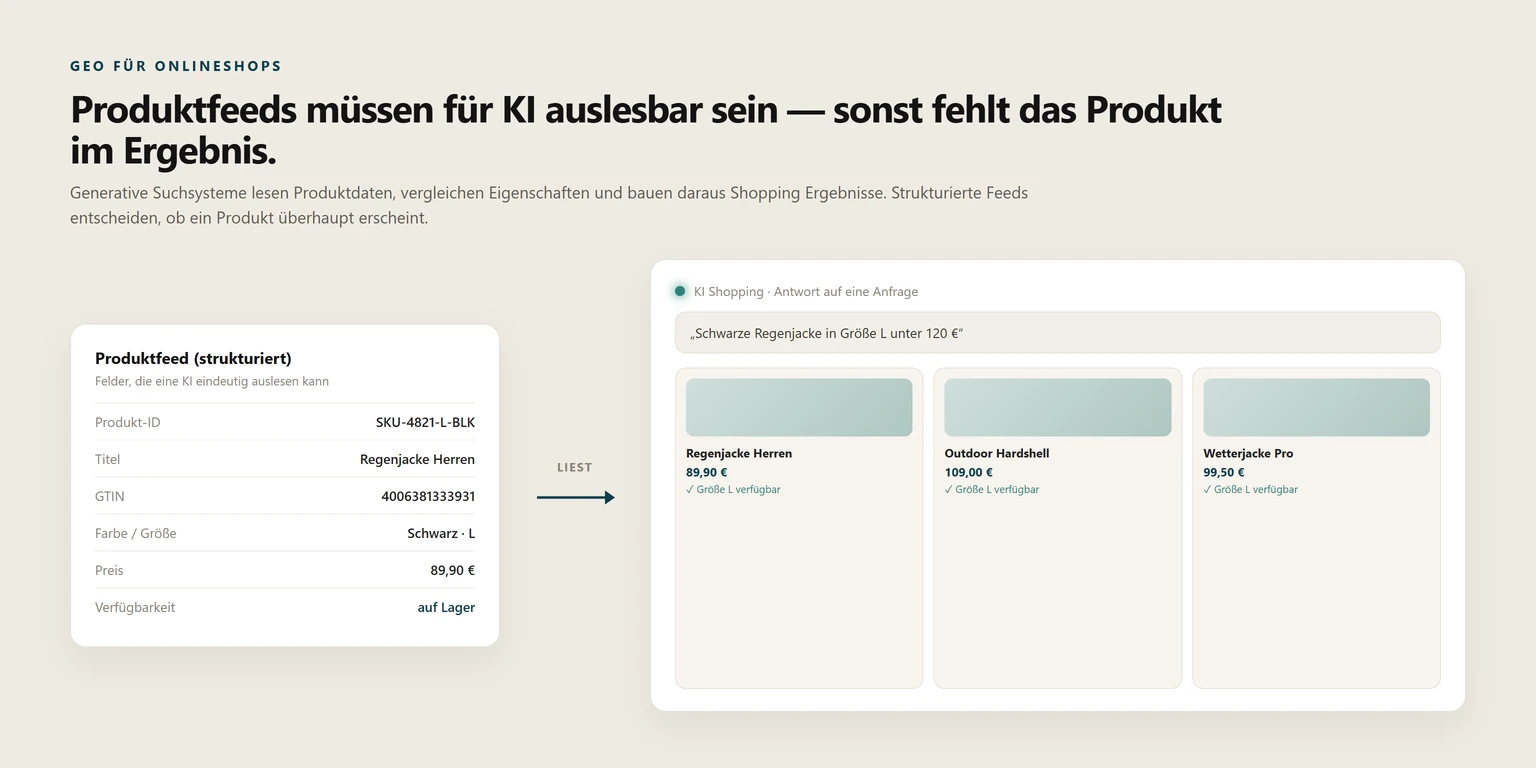
Such systems can display product cards, images, prices, retailers, availability, variants, short summaries, pros and cons, reviews, alternatives and matching accessories.
The customer doesn't have to click through ten shops first. They receive a pre-selection.
This changes the role of the shop. The product page remains important. But it is no longer always the first place where a customer understands a product. AI can take on this initial categorisation beforehand.
For a product to appear there, it needs clean data.
Why the product feed becomes the GEO foundation
A product feed is no longer just an export for Google Shopping. It becomes the technical foundation for GEO in e-commerce.
The feed needs to be able to answer an AI: What is the product? Which variant is available? What does it cost? What attributes does it have? For what purpose is it suitable? What images belong to it? Which brand, GTIN or MPN identify it? What shipping and return conditions apply?
If this information is missing, the product cannot be reliably categorised. A beautiful shop only helps so much in that case.
The data needs to be comprehensible where searching and comparison will happen in the future.
What needs to be done technically
A GEO-ready product feed requires clear structure.
Most important are: a stable product ID, a stable variant ID, an unambiguous product title, a clear description without marketing fog, brand, GTIN and MPN, clean categories and product types that genuinely match the range.
Plus price and currency, promotional prices with time period, availability, delivery country, shipping costs, return conditions, main image and additional images.
And for variants: variant groups, colour, size, material, dimensions and weight, compatibility for accessories and spare parts, and FAQ or product questions where relevant for the purchasing decision.
The goal is simple: An AI should be able to understand the product without guessing.

Variants are particularly critical
Many shops have weaknesses here.
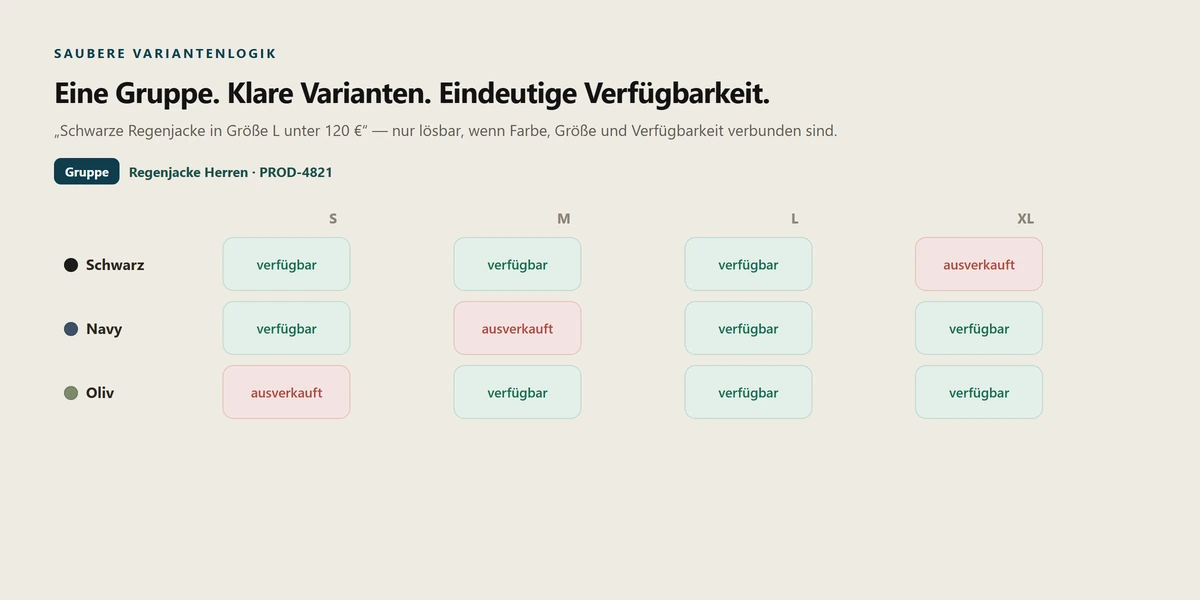
A product with several colours and sizes must not appear as many unconnected individual items. At the same time, it should not appear as one product with no clear selection.
The AI needs to understand: these variants belong together. This colour is available. This size is sold out. This image belongs to this variant. This price applies to exactly this variant.
This matters because AI queries are often very specific. For example: 'Show me a black rain jacket in size L that is waterproof and can be delivered by Friday.'
If colour, size, availability and delivery time are not cleanly linked, the product cannot be reliably shown for such a query.
Product page and feed must match
GEO doesn't end at the feed. Product page, feed and structured data must be consistent.
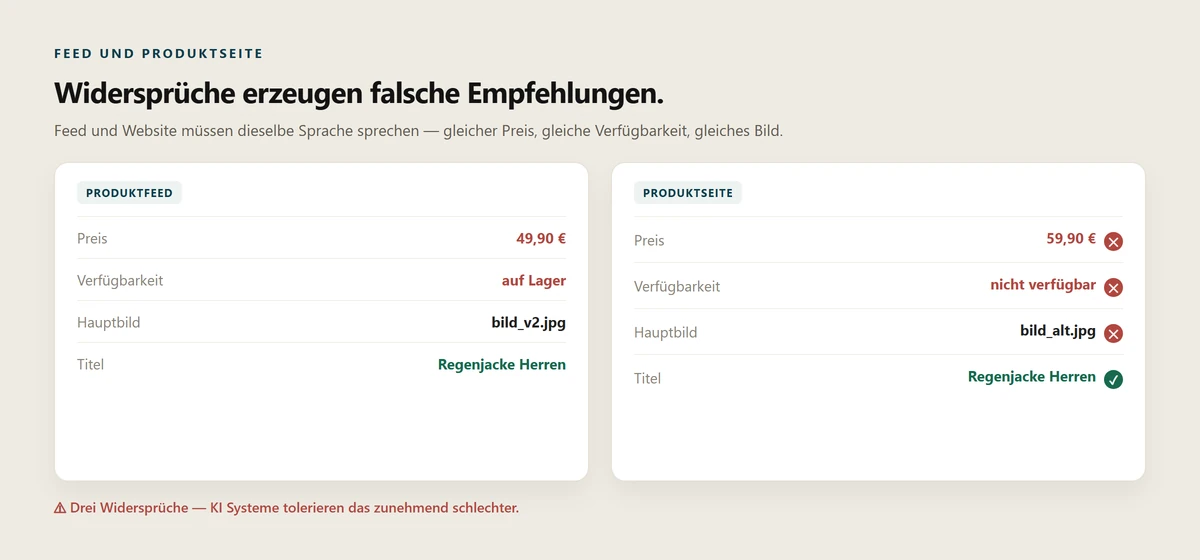
If the feed states a different price than the product page, a problem arises. If the feed says 'in stock' but the page says 'unavailable', a problem arises. If a variant in the feed has a different image than in the shop, a problem arises.
Such contradictions make it difficult for systems to use products correctly.
That's why feed, shop and structured product data need to be checked regularly.
Structured data remains important
Alongside the product feed, the product page also needs clear structured data. This includes product information such as name, image, description, price, currency, availability, condition, shipping and returns.
This data helps search systems to clearly identify a page as a product page.
For GEO, this is important because generative systems bring together various sources and signals. The feed says what is being sold. The product page explains it. Structured data confirms the key facts.
When these three levels align, a product becomes more readable.
What shops should check now
Shops should no longer check their product data only for completeness.
The better question is: Can an AI understand, compare and match this product to a relevant query?
For this, shops should specifically check: Are product titles unambiguous? Are key characteristics maintained as attributes? Are variants cleanly grouped? Are GTINs or MPNs present? Do images match the correct variant? Are price and availability current?
Further: Is shipping and returns information machine-readable? Are categories sensible? Is there structured data on the product page? Do feed and product page align? Are typical customer questions answered directly?
This is GEO work for online shops. Not inflating texts. But structuring product data so that AI systems can read it.
Conclusion
GEO is becoming important for online shops because product search is changing.
Customers no longer just search with single keywords. They describe needs, constraints and expectations. AI systems translate these queries into criteria and find matching products.
For a product to appear in such shopping results, it needs to be technically well prepared. Product feeds, variants, attributes, structured data, prices, availability, shipping and returns thus become the foundation for visibility.
Whoever today only maintains their shop pages but neglects product feeds is poorly prepared for AI shopping.
What 10LYNNDALE does in this area
10LYNNDALE reviews and optimises product feeds for GEO and modern product search.
We analyse whether product data is cleanly readable, whether variants are correctly structured, whether key attributes are missing and whether feed, product page and structured data align.
This includes titles, descriptions, categories, GTIN, MPN, variants, images, prices, availability, shipping, return information and product questions.
The goal is a product inventory that not only people understand in the shop, but that AI systems can reliably read, compare and consider in shopping results.
Next step
Similar question?
Let us look at where structure, communication or testing can make your sales path clearer.
Schedule a conversation