
Wenn wichtige Angaben wie Standards, dimensions, material, compatibility and use cases nur im PDF stehen, werden sie nicht als strukturierte Datenpunkte erkannt und ausgelesen.
Offer: AI-ready product audit
Are your products understood correctly by Google, shopping systems and AI assistants?
10LYNNDALE checks product pages, feeds, attributes, technical data, data sheets and structured data to see whether Google Shopping, Merchant Center, ChatGPT, Gemini and Perplexity can read, classify and reproduce your products correctly. For technical retailers, B2B shops and manufacturers whose product knowledge sits in the wrong places.
Check product data, feeds and product pages for machine readability.
Spot problems in attributes, variants, data sheets and Merchant Center.
Receive concrete measures for better visibility, cleaner data structure and unambiguous enquiry paths.

Direct answer
What is an AI-ready product audit?
An AI-ready product audit is a structured review of product data, product pages, feeds and data sheets. The aim is to establish whether search engines, shopping systems and AI assistants can read, compare and reproduce technical products correctly.
Technical products aren't understood through nice copy alone, but through clear data points: product type, material, standard, dimensions, compatibility, application, variant, availability, price, structured data and consistent feed output. If those data points are missing or contradict each other between shop, feed and Merchant Center, visibility and delivery problems follow.
The audit doesn't show whether your site looks good. It shows whether your products are understood.
The problem
Your products are online. For machines they often aren't clearly readable.
Many technical companies have enough product knowledge. It simply sits in the wrong places: in PDF data sheets, old shop texts, Excel lists, product feeds, ERP data, catalogues and in individual people's heads.
For people that is sometimes enough. For search systems, shopping platforms and AI assistants it often is not. With product data, AI rarely fails because of the tool. It fails because of unclear, contradictory or unreadable information.
Wenn Shop, feed and Merchant Center unterschiedliche Angaben zu Preis, Versand oder Verfügbarkeit ausgeben, entstehen Ausspielungs- und Ablehnungsprobleme bei Google Shopping.
Wenn Variants, standards, dimensions or applications nicht sauber getrennt sind, können Produkte von Suchsystemen falsch eingeordnet oder gar nicht gefunden werden.
Common findings
Typical problems the audit uncovers.
Technical data only exists in the PDF
Search and AI systems don't read the specifications as data points.
Product attributes are missing or named differently per category
Filters and comparison systems cannot classify products clearly.
Product titles are too generic
Too little product type, application, material or standard. Not distinguishable from hundreds of similar results.
Variants aren't cleanly separated
Machines assign sizes, versions and material variants incorrectly.
Material, standard, dimensions or application are missing as separate fields
Information exists only as running text or PDF. No structured data point.
Product feed and product page contradict each other
Different prices, shipping details or descriptions lead to delivery problems.
Merchant Center receives different details than the shop
Products get rejected or delivered with restrictions.
JSON-LD is incomplete or faulty
Structured data exists but isn't used reliably by search engines.
Product texts are interchangeable
No clear differentiators, no quotable content for AI systems.
Internal search and filters don't use technical features
Customers can't find products, even without an SEO problem.
AI systems name competitors instead of your products
Their product data is structured more clearly and gets cited more often.
Areas reviewed
What 10LYNNDALE checks in the audit.
We check whether your product data is unambiguously readable along the whole chain: from the product page to AI search.
Product pages
Product title, description, technical details, use cases, FAQ, enquiry path. Are products built so that people and machines grasp the essentials immediately?
Product data and attributes
Material, dimensions, standards, compatibility, variants, categories, filters, mandatory fields. Which details are missing as separate data points, which are named inconsistently?
Data sheets and PDFs
Which information exists only in the PDF? Which details have to be available as structured data points on the product page, in the feed or at attribute level so search systems can read them?
Product feed and Merchant Center
Completeness, consistency, price, shipping, availability, GTIN/EAN, category, variant logic, rejection risks. Do shop, feed and Merchant Center match?
Structured data
JSON-LD, Schema.org, product markup, breadcrumbs, organization, FAQ. Which details are machine-readable, which are missing or faulty?
AI visibility and GEO
Can ChatGPT, Gemini, Perplexity and generative search systems understand your products, summarise them and name them as a fitting solution? Where do products lose ground against competitors?
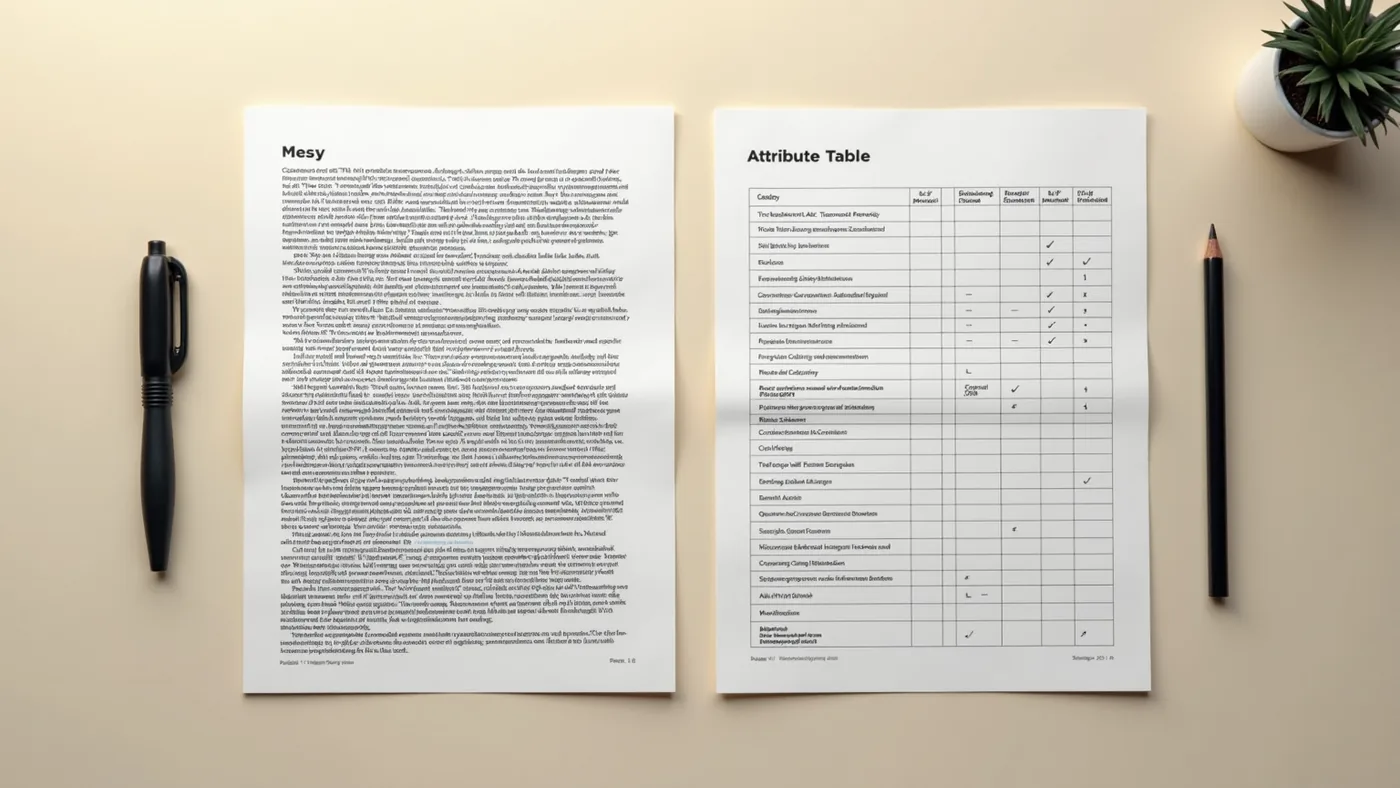
From PDF data sheet to a readable attribute table
We show on your real products how unstructured data sheets become clean data points: material, standard, size, application, compatibility and availability as separate fields.
Example
Why a product isn't understood clearly.
Illustrated with a typical B2B product from the road safety sector.
Before
Warning marking, red and white
High-quality warning marking for various applications.
Problems
- ✕Material, dimensions, reflection class, standard, temperature range and applications only appear in the PDF data sheet.
- ✕Applications are missing as structured details.
- ✕Variants aren't cleanly separated.
- ✕The product feed contains less information than the product page.
Clear to people. Too vague for machines.
After
Warning marking, red and white: structured data points
Custom fields
- ✓Product type: warning marking
- ✓Material: PVC film
- ✓Standard: EN ISO 20471 / RAL
- ✓Reflection class: class 1
- ✓Dimensions: 50 mm × 33 m (per variant)
- ✓Adhesive: permanent, solvent-free
- ✓Application: traffic safety, machine marking
- ✓Indoor / outdoor: suitable for outdoor use
- ✓Surface: metal, plastic, glass
- ✓Temperature range: −20 °C to +70 °C
- ✓Availability: in stock
With cleanly separated data points, Google Shopping can assign the variant correctly, an AI assistant can name the standard and the application, and a buyer can find the right product through the filter.
The outcome
What you receive after the audit.
You don't get a generic SEO presentation. You get a clear finding on one selected product area or on representative products from your range.
Prioritised list of issues
Assessment of product pages, attributes, data sheets, feed and structured data
Concrete measures for shop, product data and Merchant Center
Examples of better product titles and attributes
Notes on missing technical data
Assessment of which information AI systems probably cannot read reliably
Recommendation on what to fix first
Optional proposal for the implementation
Suitable cases
Who is the audit for?
Technical retailers with products and specifications that need explaining.
B2B shops whose data upkeep has become messy over the years.
Manufacturers with digital product catalogues that don't show their full product knowledge online.
Shops with many PDFs and data sheets whose content isn't machine-readable.
Companies with feed problems or recurring rejections in Merchant Center.
Ranges with many variants, standards, dimensions and materials.
Industrial supplies, occupational safety, traffic safety, reflective films, machine accessories, spare parts, technical films, construction supplies, fastening technology.
For context
Who is the audit not intended for?
Shops selling only simple consumer products without technical specifications.
Companies primarily looking for a new website design.
Companies unwilling to structure product data over the medium to long term.
Projects that just want AI-generated text quickly, without improving the data basis.
Why 10LYNNDALE
Not the classic agency perspective.
10LYNNDALE doesn't come from the classic agency world, but from running technical websites, shops and product data. That means experience with product pages, shop structure, SEO, product data, inventory management, marketplaces, migrations, error analysis and technical content.
The audit therefore looks not only at design or copy, but at the whole chain: product knowledge, data structure, feed, search systems, AI visibility and enquiry path. The result is not a concept paper but a concrete finding on your products.
B2B website & conversion
Product pages that don't just get found but lead to an enquiry. With a clear structure for decision-makers.
Product data & feed structure
Attributes, variants, data sheets and feeds — clean and machine-readable. Consistent across shop, feed and Merchant Center.
AI-readable content & GEO
Copy and structured data that search and AI systems can read and quote as solid facts.
Why now?
B2B research is changing.
Buyers no longer search only through classic result lists. They increasingly use Google Shopping, Google AI Overviews, ChatGPT, Gemini and Perplexity for research and supplier shortlisting. These systems assemble their own answer and decide which products and suppliers get named.
These systems can only name products when data is unambiguous, consistent and readable. Classic SEO stays important, but for technical products it is no longer enough on its own. Anyone relying on running text, PDFs and weak attributes becomes harder to compare and gets mentioned less often.
The audit shows whether your data can be read unambiguously by these systems at all — before you invest in individual measures.
Contact
Have it checked what machines read from your products.
If your product information sits in PDFs, old shop texts, spreadsheets or inconsistent attributes, a large AI project is usually the wrong first step. A clearly bounded audit makes more sense: one product area, representative products, a concrete list of issues, clear priorities.
FAQ
Frequently asked questions
What is an AI-ready product audit?
A structured review of product data, product pages, feeds and data sheets. The aim is to establish whether search engines, shopping systems and AI assistants such as ChatGPT, Gemini and Perplexity can read, compare and reproduce technical products correctly. The result is a prioritised list of issues with concrete measures.
Is this SEO or GEO?
Both, with a different focus. Classic SEO targets rankings in Google search. The audit additionally checks whether your product data is readable for Google Shopping, AI answers and generative search systems. That field is called Generative Engine Optimization (GEO).
Does the shop have to be rebuilt for this?
No. The AI-ready product audit is not relaunch consulting, but a review of your existing product data, product pages and feeds.
The aim is first to find out which information is missing, which data is not unambiguous enough and where shop, feed and Merchant Center contradict each other.
Most findings concern content, attributes, technical data, variant logic, structured data or feed output — not automatically the shop system itself.
Is the audit tied to a particular shop system?
No. The audit doesn't examine the system itself, but whether your product data, product pages, attributes, technical information, feeds and structured data are cleanly built and unambiguously readable.
The audit suits existing B2B shops, e-commerce systems, manufacturer sites and digital product catalogues, regardless of the shop system in use.
Does 10LYNNDALE also check Merchant Center and Google Shopping?
Yes. Feed and Merchant Center data are checked for completeness, mandatory fields and consistency — including common rejection reasons such as missing GTIN/EAN, gross/net discrepancies or diverging shipping costs.
Why aren't PDF data sheets enough?
PDFs are readable for people, but for search engines, Google Shopping and AI systems they aren't reliably accessible as structured data points.
If material, standard, dimensions, reflection class or applications only appear in the PDF, those details can't be indexed, compared or quoted as separate fields. Search systems and AI assistants can only read product knowledge unambiguously when it exists as structured, machine-readable data — not as an image or running text in an attachment.
How many products get reviewed?
The audit can start with one selected product area or with representative products. The exact scope is agreed in advance, depending on range size, category structure and the main problems to be examined.
Do I only get an analysis, or the implementation as well?
The audit ends with an analysis and prioritised recommendations. You can implement it yourself, hand it to your team, or commission 10LYNNDALE. You decide after the findings.